Claude Opus 5.5 vs Claude Sonnet 5.5: Two Points, Double Price?


Claude Sonnet 5.5 is the smarter buy for most people. It scores 56 on Artificial Analysis against Opus 5.5's 58, yet costs half as much. The two-point gap is real but thin, and unless your workload lives at the very edge of reasoning, paying double is hard to justify. This is a rare case where the cheaper model almost catches its big brother.

The benchmark gap is tiny
Artificial Analysis puts Opus 5.5 at 58 and Sonnet 5.5 at 56 with max effort on both. That's a 3.4% difference, not a generational leap. On routine coding, summarization, and agentic tasks, you'd be hard pressed to notice it. The gap only starts to matter on long, multi-step reasoning problems where Opus 5.5 keeps its chain-of-thought tighter. For everyone else, Sonnet 5.5 feels like the same model with a slower heartbeat.
Price doubles, value doesn't
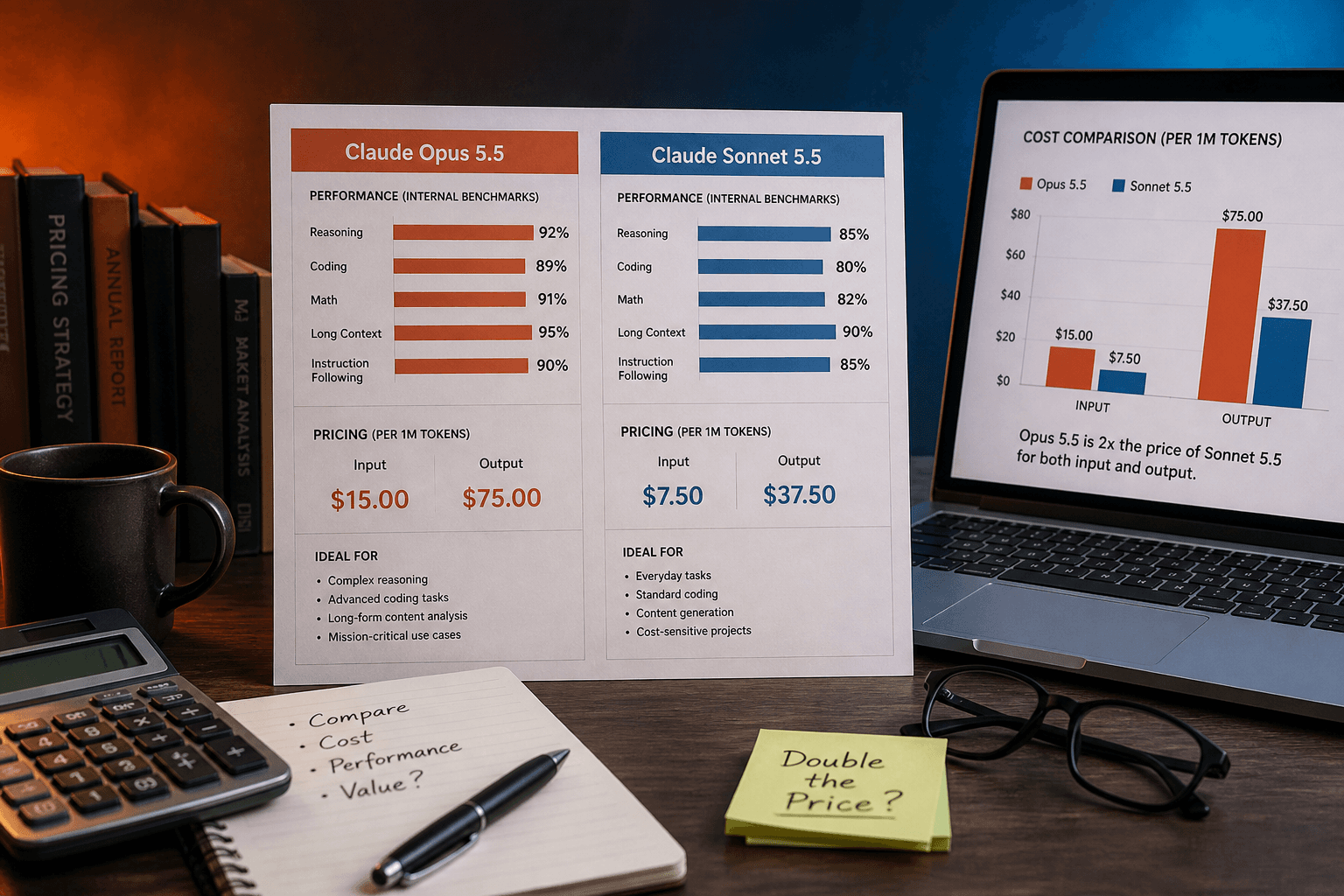
Here's the raw math: Opus 5.5 runs $4.00 per million input tokens and $20.00 per million output. Sonnet 5.5 runs $2.00 in and $10.00 out. That's exactly double across the board. If you process a million output tokens a day, the Opus surcharge adds $10,000 a month over Sonnet. For that money, you get two extra benchmark points. Unless your project literally fails at 56 but succeeds at 58, that's a luxury tax, not a productivity tool.
Which one suits who
Sonnet 5.5 fits startups, high-volume pipelines, and anyone watching token burn. Opus 5.5 fits research teams, complex math, and production systems where a rare wrong answer costs more than the price difference. Both share the same family strengths, so pick by failure tolerance and budget, not hype.
Verdict: which one should you pick?
Pick Claude Sonnet 5.5 for everyday coding, chat, and cost-sensitive workflows. Pick Claude Opus 5.5 only when you've measured Sonnet 5.5 failing on your hardest tasks. Default to the cheaper one, upgrade on evidence.