Claude Opus 5 vs GPT-6 Astra: Coding Speed vs Long-Horizon


Claude Opus 5 and GPT-6 Astra are both serious coding models, but they win different tests. If you mostly fix bugs in a repo, Opus 5 is the safer bet. If you need an agent to grind through a multi-step engineering task, Astra looks stronger. Neither is the overall winner, and the numbers prove why.
Benchmarks measure different jobs
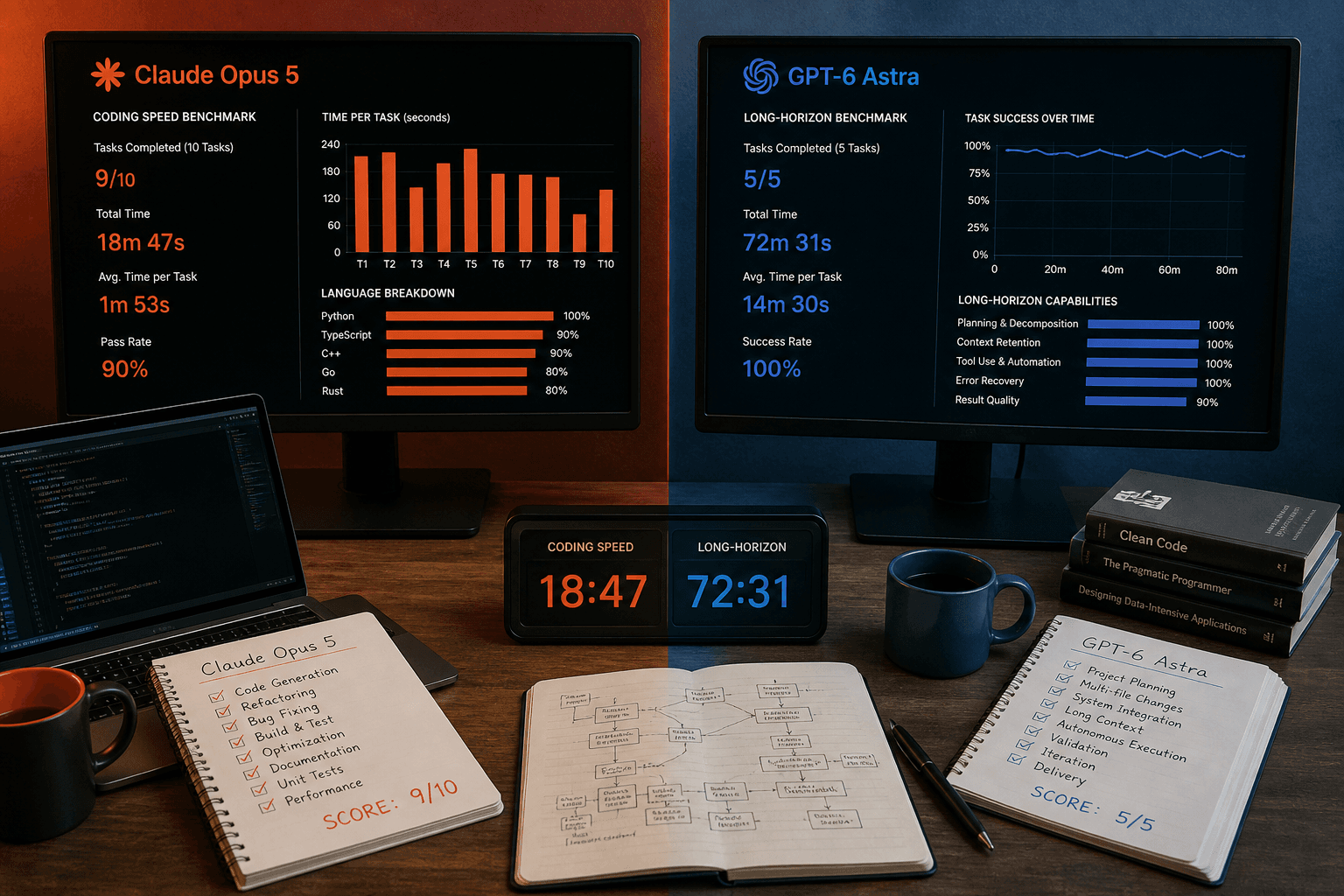
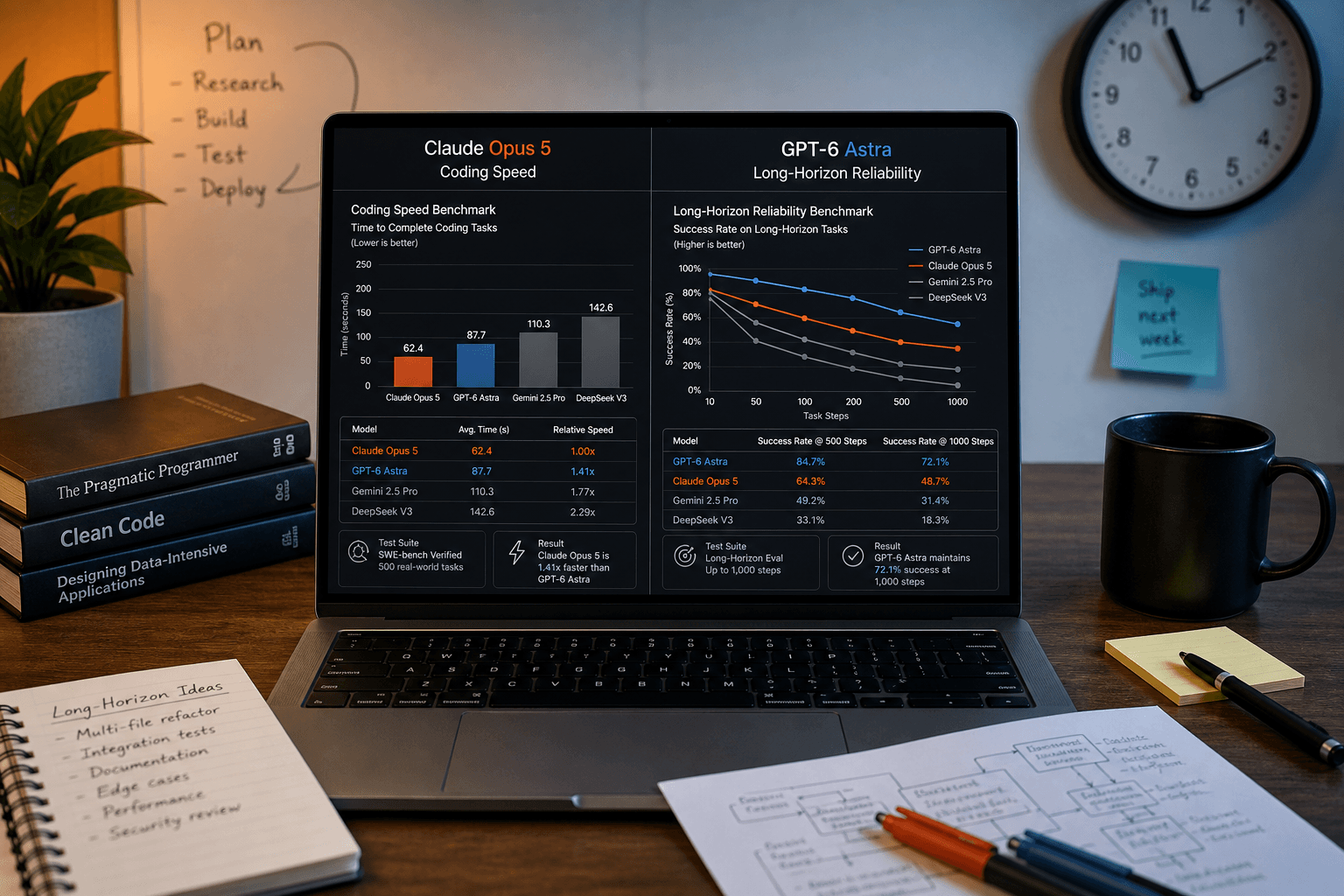
Claude Opus 5 hits 97.00% on SWE-Bench Verified, the classic benchmark for real-world bug fixes. GPT-6 Astra only shows 74.1% on DeepSWE, a tougher long-horizon software engineering test. Those numbers aren't directly comparable, though: the source explicitly warns that DeepSWE results vary with evaluation setup, and seven models now clear 95% on SWE-Bench, so that leaderboard is crowded.
Price doubles the decision
Opus 5 costs $5.00 per 1M input tokens and $25.00 per 1M output tokens. Astra runs $10.00 and $50.00 — exactly double. If your work is mostly short, well-defined coding tasks, the cheaper model looks smart. If you're running long agentic pipelines that need deeper planning, the extra cost might pay for itself. You only know by testing on your own workload.
Which one fits your workflow?
Pick Claude Opus 5 for rapid bug fixes, code review, and tasks where the endpoint is clear. Pick GPT-6 Astra for long-horizon agent work where the model has to keep context across many steps. Neither is a universal “best”; they're tuned for different definitions of coding.
Verdict: which one should you pick?
Choose Claude Opus 5 if you want proven SWE-Bench Verified performance at half the price. Choose GPT-6 Astra if your agents need to survive longer engineering sessions and you can afford the higher token bill. Validate both on your own tasks first — the benchmarks don't tell the full story.