GPT-5.5 vs Claude Opus 4.8: The $5 Mid-Tier Face-Off

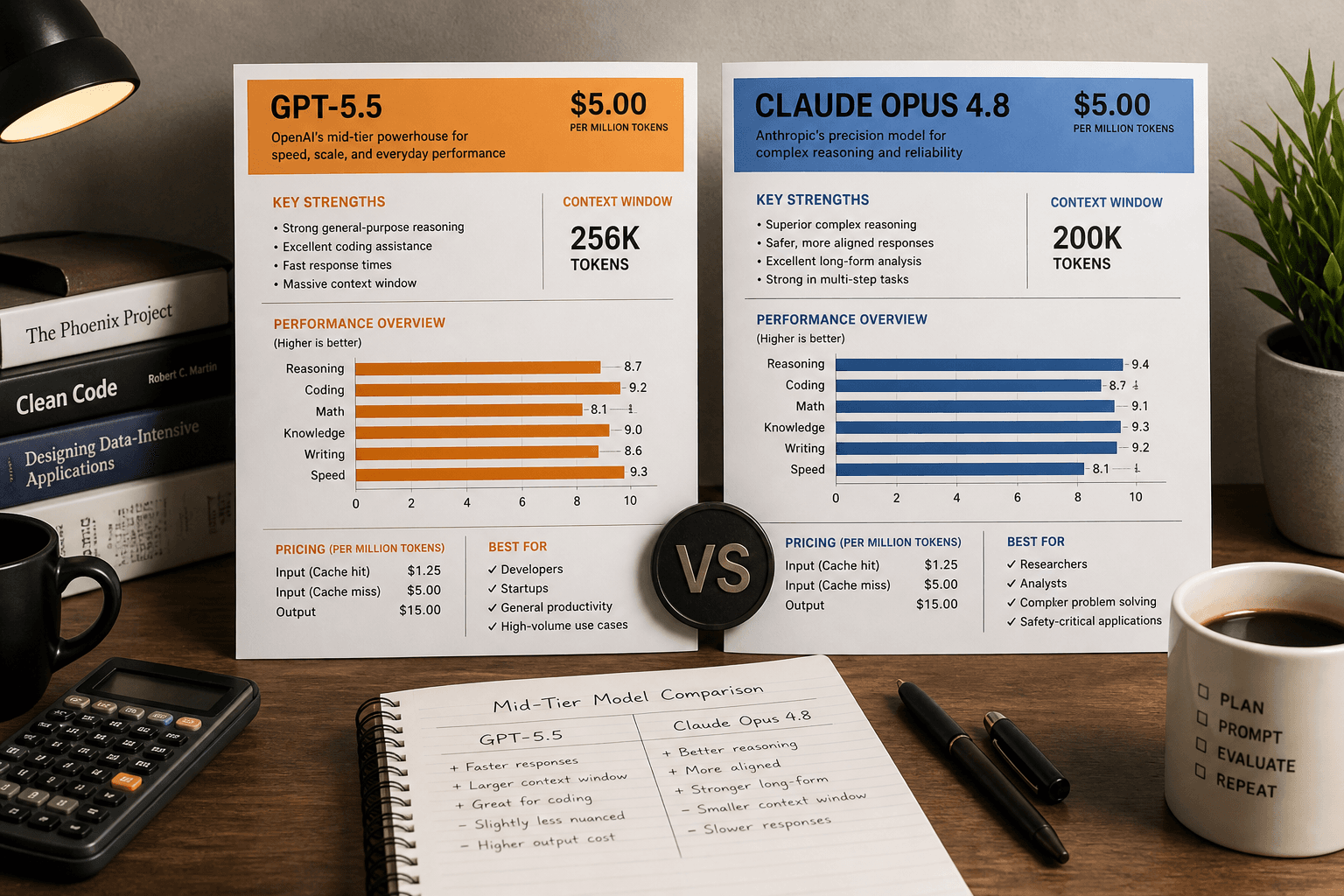
If you're shopping around $5 per million input tokens, this is the fight that matters right now. GPT-5.5 costs $5.00/1M in and $30.00/1M out; Claude Opus 4.8 runs $5.00/1M in and $25.00/1M out. Both sit below the $10 flagships while still demanding a premium over budget models. My verdict: Claude Opus 4.8 is the smarter pick for long, writing-heavy contracts, while GPT-5.5 takes the edge for tool-calling and general coding workflows.
Coding and Tool Use
GPT-5.5 keeps OpenAI's strength in structured, agentic loops. It handles multi-step tool chains with less hand-holding and rarely loses context in long function definitions. Claude Opus 4.8 is closer to a careful senior reviewer: it writes cleaner refactors but can be more conservative when you need fast iteration. If your CI/CD pipeline depends on autonomous completion, GPT-5.5 moves faster.
Output Quality and Price Per Word
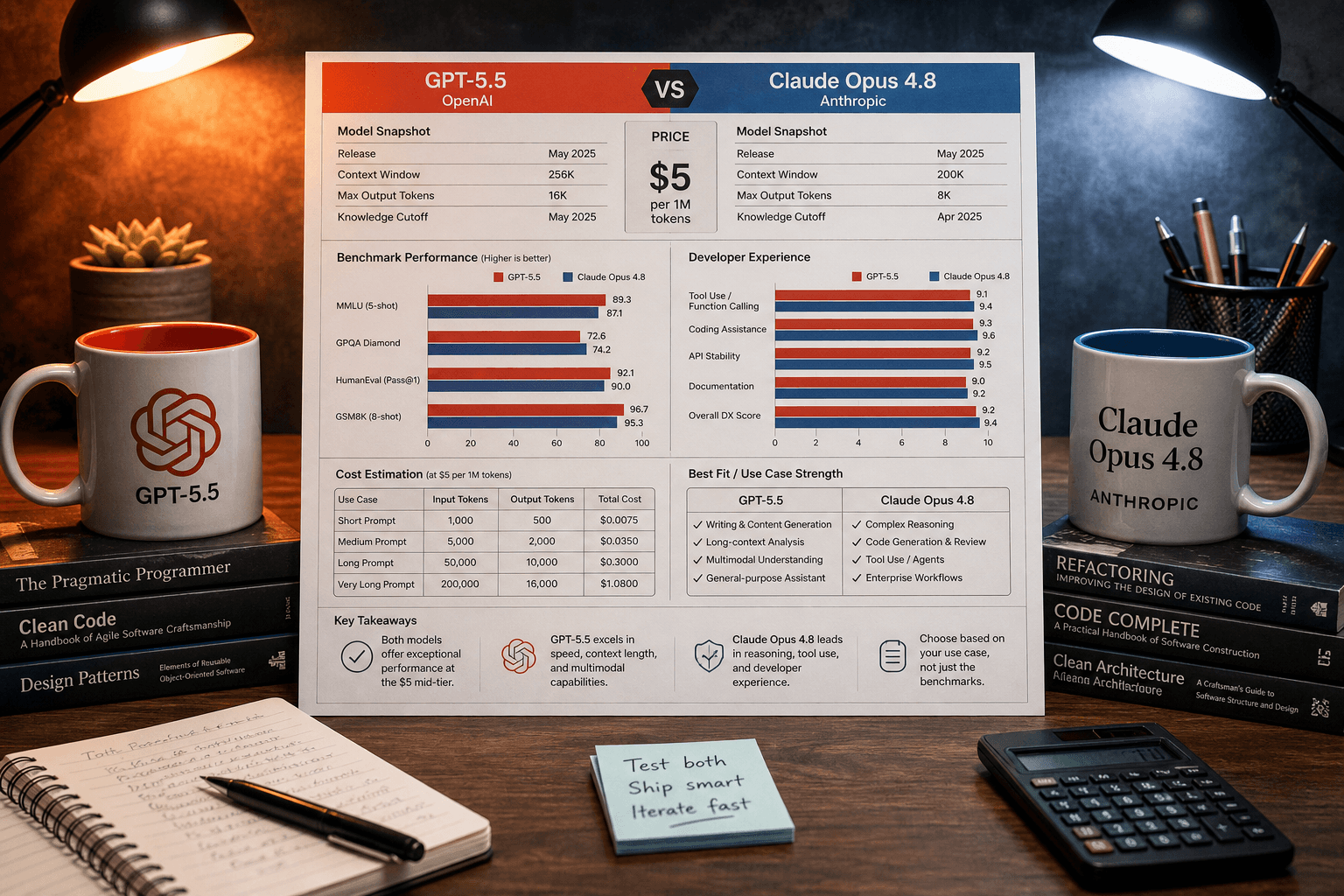
Claude Opus 4.8 is $5.00/1M cheaper on output versus GPT-5.5's $30.00/1M out. That adds up fast on long-form codegen or documentation. Opus also reads as more natural in prose and nuanced explanations, matching what most people expect from Anthropic's writing style. If you generate 100M output tokens a month, that's a $500 difference in your favor.
Context and Stability
Both handle lengthy codebases fine, but Opus 4.8 has a calmer temperament: fewer mid-task refusals, less hallucinated API calls. GPT-5.5 can occasionally over-engineer simple requests. Neither wins on raw speed; both are middle-of-the-pack compared to flash-class models.
Verdict: which one should you pick?
Choose GPT-5.5 if your work is automation-heavy and you need a model that plugs into tools without babysitting. Choose Claude Opus 4.8 if you value consistent output quality and lower output spend — especially for documentation, review, and long-form generation where every token costs real money.