



NVIDIA Kumo Forecast Aims to Make Time-Series AI Explainable


NVIDIA released Kumo Forecast, a new approach to time-series prediction that combines pretrained representations with retrieval of historical patterns. The company says the method improves accuracy on forecasting tasks while keeping results interpretable for analysts. That matters because businesses using AI for demand planning, finance, or operations often need to explain why a model made a call — not just get a number.
What does Kumo Forecast do differently?
Most forecasting models either train from scratch or use a fixed pretrained backbone. Kumo Forecast adds a retrieval step: it looks for similar patterns in past data and uses those as reference points. The design mimics how human forecasters check history before projecting forward. According to NVIDIA's write-up on Hugging Face, the pretrained representations let the model generalize across domains, while retrieved patterns ground predictions in concrete prior events.

Who is this built for?
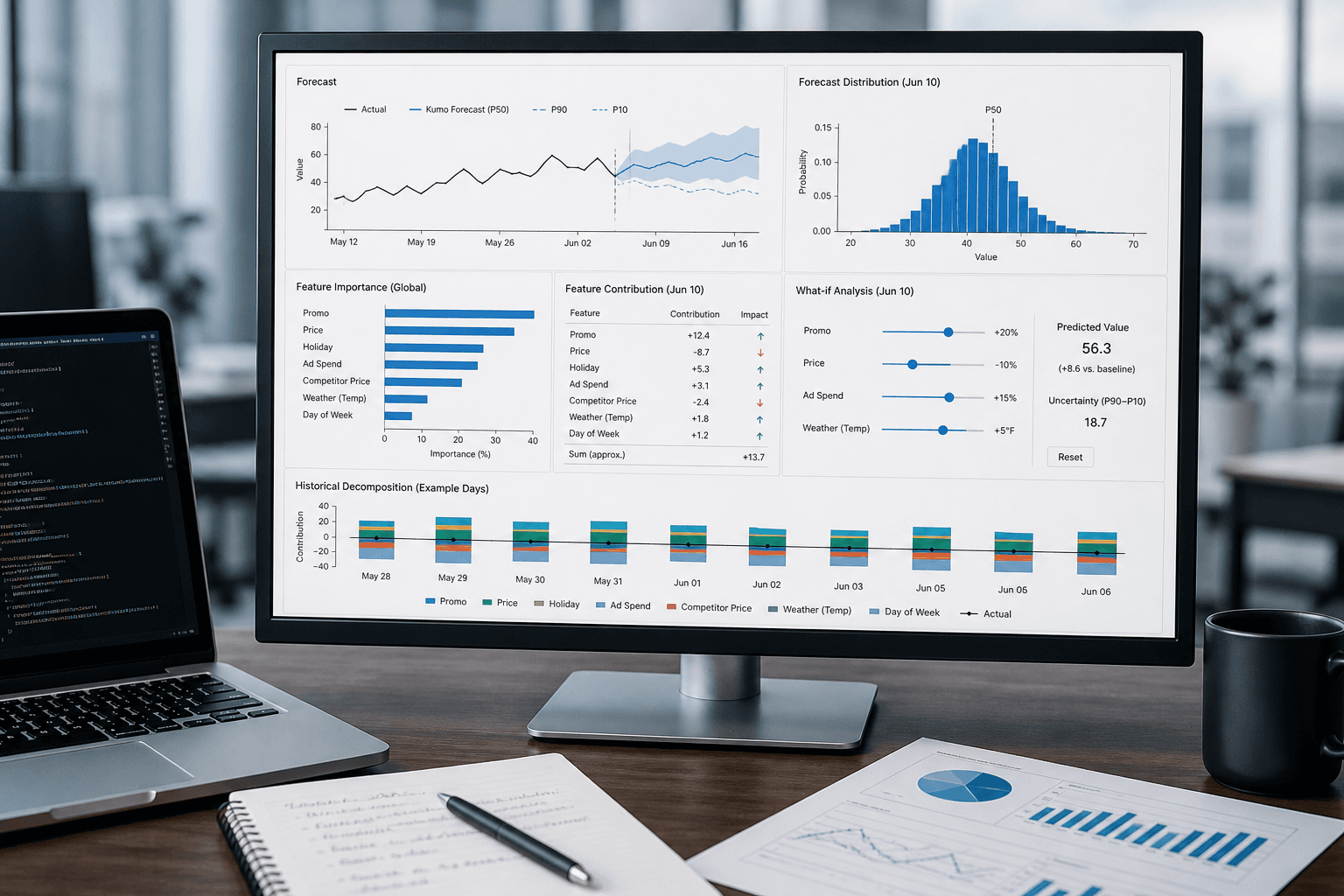
NVIDIA positions Kumo Forecast for data science teams that need reliable, auditable forecasts. The reference implementation is available on Hugging Face, and developers can test it against their own time-series datasets. The release includes benchmark comparisons, but NVIDIA has not announced a commercial product or API pricing yet. The community reads this as a research-grade open model first, with possible enterprise packaging later.
This looks like a step toward making AI forecasting less of a black box. Whether it translates into real-world accuracy gains over simpler baselines is still an open question. But the focus on interpretability is a direct answer to a common enterprise complaint.