Qwen3.8 Max vs Claude Sonnet 5: Open vs Closed at $2


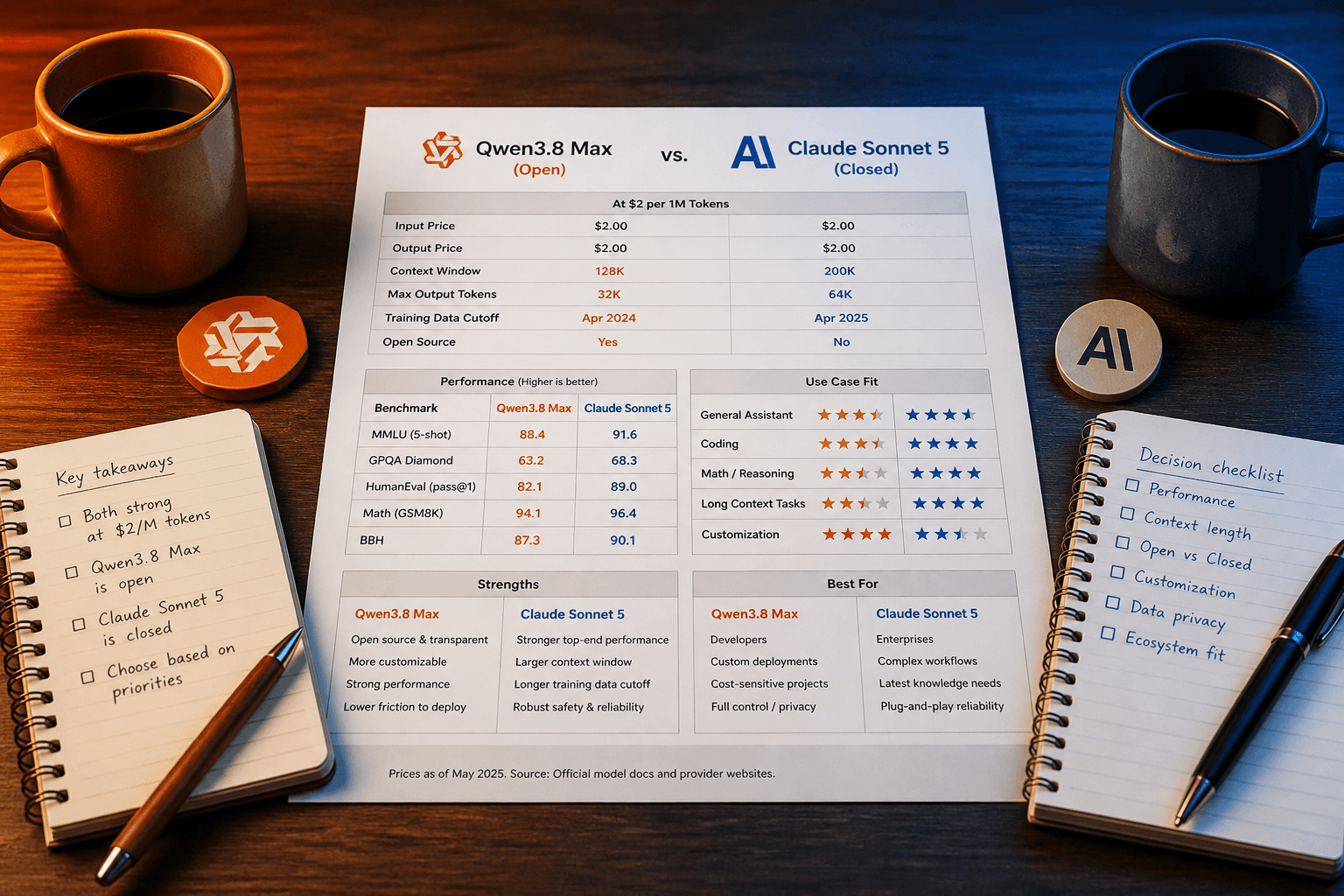
Qwen3.8 Max beats Claude Sonnet 5 on value, but Sonnet 5 still wins on polish. At $2.00 per million input tokens, Qwen3.8 Max gives you a 3x cheaper output price at $6.00 versus $10.00, plus open weights for local deployment. Claude Sonnet 5 counters with stronger agentic reliability and multimodal chops. If you need privacy and cost control, Qwen wins. If you want plug-and-play quality, Claude takes it.
Price and flexibility
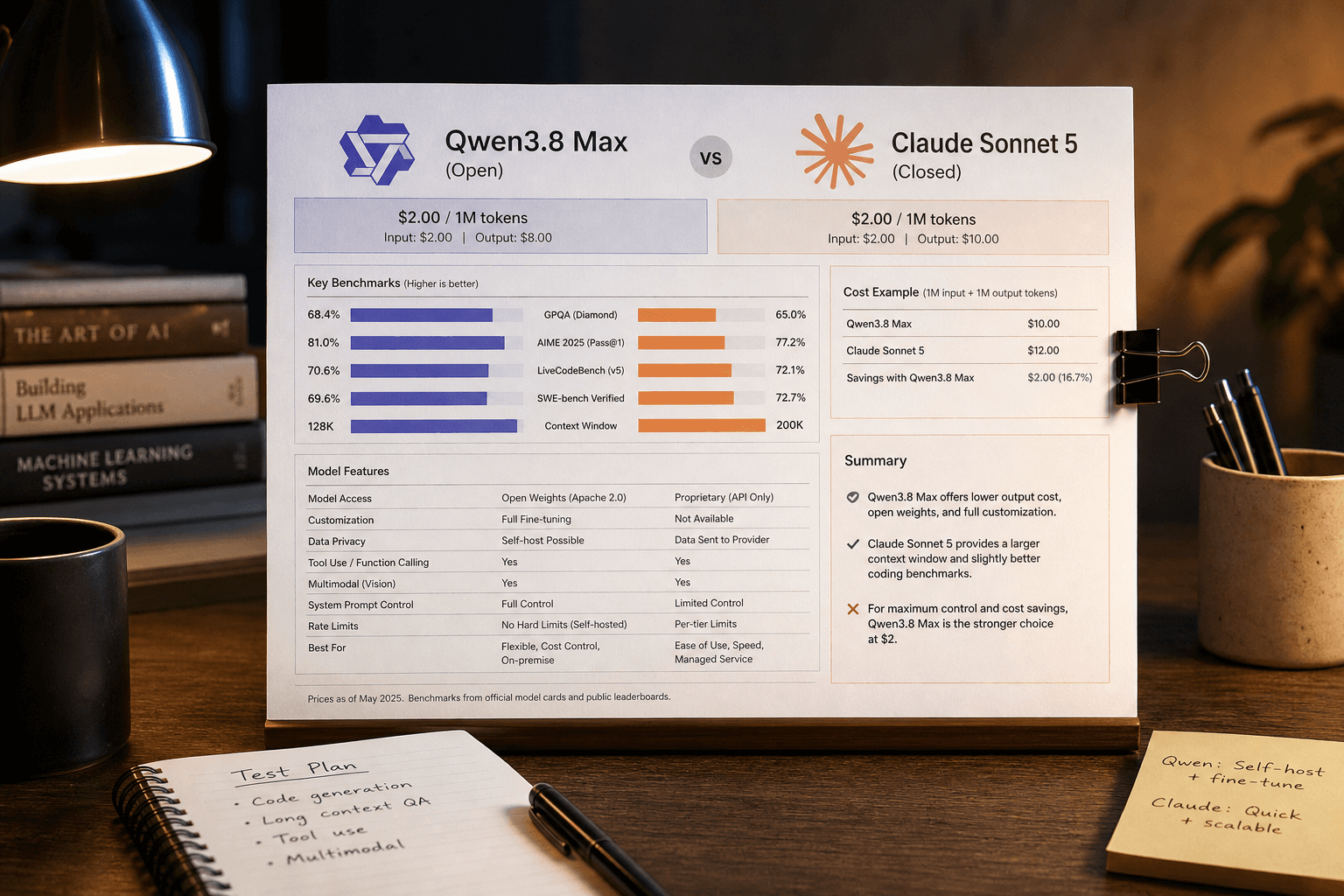
Qwen3.8 Max costs $2.00/1M in and $6.00/1M out, while Claude Sonnet 5 runs $2.00/1M in and $10.00/1M out. That 40% output discount matters for high-volume generation. But Qwen is open-weight, so you can self-host and fine-tune on proprietary data—huge for companies with data residency rules. Claude is API-only, locked to Anthropic's infrastructure.
Reasoning and real-world tasks
Recent benchmarks show the open-closed gap has narrowed significantly. Qwen3.8 Max isn't in the headline reasoning scores like GPT-5.4 Pro's 9.5/10, but it holds its own on everyday tasks. Claude Sonnet 5 has a more consistent track record on complex agentic workflows and multimodal inputs, where Qwen3.8 Max lags. For simple structured tasks, Qwen feels nearly as sharp; for messy real-world calls, Claude earns its premium.
Coding and throughput
Neither model tops the coding charts—that's Devstral 2 2512 territory at 8.5/10 cost-efficiency. But Qwen3.8 Max offers faster token throughput at lower cost for bulk code generation. Claude Sonnet 5 is better at debugging and following intricate instructions, making it the safer bet for production codebases.
Verdict: which one should you pick?
Choose Qwen3.8 Max if you want open weights, cheaper output, and don't need multimodal flair. Choose Claude Sonnet 5 if you want reliable agentic behavior and top-tier instruction following, and you're okay paying more per output token. Your call depends on whether the 40% savings outweigh Claude's polish.